

If you spend enough time in owners corporation meetings, you start to hear the same questions again and again.
“Where can I charge my new EV? or … Can I wire a charger back to my unit?”
It sounds simple, but it rarely is. Committees are left trying to balance competing concerns. Avoid overloading ageing electrical infrastructure. Ensure costs are allocated fairly. Avoid a major electrical capital upgrade that may only benefits a handful of residents, at least for now.
It was against this backdrop that I caught up with Charlie Richardson, Chief Operations Officer at NOX Energy and self-described “Equitable eMobility Evangelist”, over coffee in late 2024. Charlie had claimed he had a solution to this exact problem. I was sceptical, but curious.
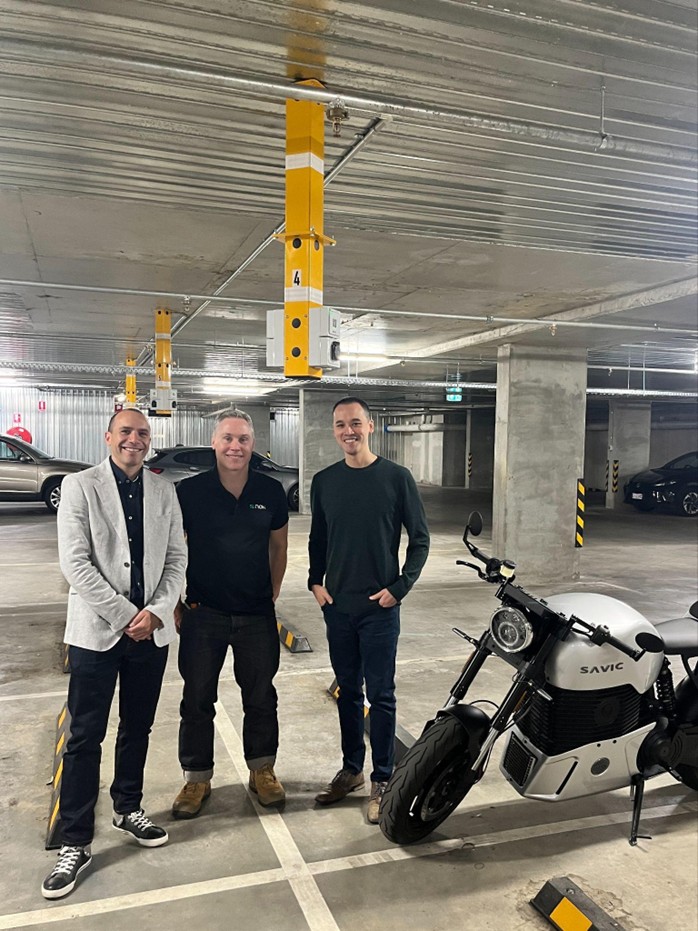
Julian Louey of Stratablox (right) with Charlie Richardson of NOX Energy (centre) and Jake Sharp, founder of MiMOR (left). Fancy electric motorbike (far right).
After a few laughs about our shared experiences in the strata world, we got into the detail.
What Charlie proposed was a different way of thinking about EV charging in apartment buildings.
Rather than defaulting to expensive upgrades to switchboards and cabling, the NOX Energy Intelligent Power Socket (IPS) works with what most buildings already have. In many cases, it can replace a standard power outlet or be installed as a new outlet without major infrastructure works. The implication is significant. Instead of building for a small number of high-powered chargers, you can enable access across an entire car park.
Of course, infrastructure is only part of the problem. In my experience, proposals often fall over when the question of fairness arises.
Who pays for the electricity?
How is usage tracked?
And how do you avoid one group of owners subsidising another?
Each IPS device measures individual energy consumption, ensuring users only pay for what they use, while the relevant meter owner is reimbursed. It removes the need for internal cost allocations, spreadsheets, and the inevitable payment disputes that follow.
The system also addresses one of the more practical concerns that committees raise, being safety and capacity. The platform monitors each device in real time and incorporates load management to ensure charging demand stays within the limits of the building’s existing electrical infrastructure. Multiple vehicles can charge simultaneously without pushing the building beyond its capacity.
That said, like any solution, it is not without trade-offs. Charging speeds are generally lower than traditional Level 2 chargers, which means the model works best in environments where vehicles are parked for extended periods, such as overnight. In a residential setting, that is often a very reasonable compromise.
If your building does not have wi-fi in the car park or is large and doesn’t have cable trays, these issues will need to be resolved. If you’re wondering how NOX get paid, they take a small cut from the electricity tariff which is paid by the user, not the owners corporation.
Shortly after that initial meeting, I identified a Tier 1 development in Hawthorn that presented the perfect opportunity. Working closely with NOX Energy, we developed a proposal tailored to the building. This included not just the devices themselves, but also the practical considerations around connectivity, layout and minimising costs.
In September 2025, NOX Energy received a $1.51 million grant from the Australian Renewable Energy Agency (ARENA) under the Driving the Nation Program to support EV charging in strata communities. The Hawthorn development was selected to participate, which significantly accelerated the project.
With grant funding now available, we pursued a more ambitious approach. What if every car space could be equipped with its own IPS? The objective was to solve the EV charging dilemma, future-proof the building, and add tangible value and amenity to each car space.
The building later went on to install more than 250 IPS devices, effectively providing every resident with access to their own private, load-managed charging point. No waiting lists. No visitor car spaces required. No disputes over payments. No need for costly electrical supply upgrades.
On 17 March 2026, the project was formally launched with the Federal Minister for Climate Change and Energy, Chris Bowen, attending to cut the ribbon. It was a proud moment, not just because of the scale of the installation, but because it demonstrated what is possible in owners corporations with forward thinking.

Thea op den Brouw of Stratablox was present to witness Chris Bowen cutting the ribbon at the Tier 1 Hawthorn development.
For us at Stratablox, this project reflects a broader approach to management. Our role is not just to respond to issues as they arise, but to anticipate them and work with committees to implement solutions that are cost effective, compliant and practical.
EV charging is quickly moving to an expected part of apartment living. The buildings that plan early and implement the right systems will avoid a lot of complexity down the track.
If you are starting to have these conversations within your building, it is worth exploring what options are available and, just as importantly, which ones are actually suited to your specific circumstances.
And for the record, Stratablox has no commercial arrangement with NOX Energy, although Charlie did pay for my coffee! Having been involved with a project of this scale, we are well placed to assist other buildings considering a similar path.
Julian Louey
Managing Director at Stratablox
www.stratablox.com.au